
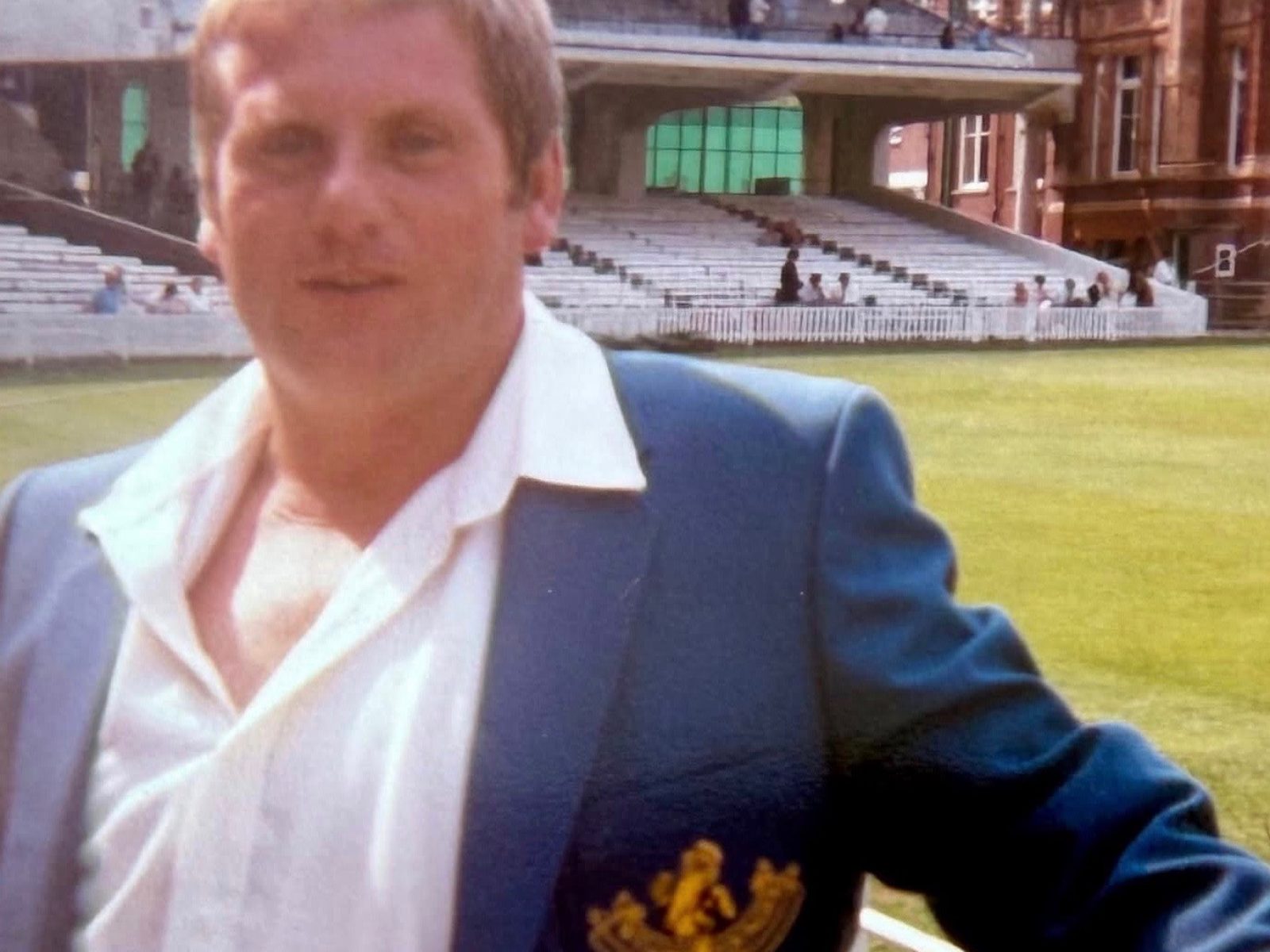
A tribute by John Hulme, Chairman of Shropshire County Cricket Club and a Life Member of Shrewsbury Cricket Club
There are very few certainties in the game of cricket, as in all sport, but it can be safely said that Bill Welder Davies of Shrewsbury Cricket Club will be long remembered as one of Shropshire cricket’s most outstanding characters of his generation.
Rarely can there have been a more popular and well met fellow. His contribution to the London Road club, both as player and groundsman, and to cricket generally throughout the county, was inestimable. He enriched so many lives.
Without equivocation or fear of contradiction, there will never be another “Welder!’. He was truly quite unique.
Born shortly after the start of the second world war in Montford Bridge, where he grew up, Bill, upon leaving school, worked briefly for a local building firm before undertaking his National Service. It was in the Army that Bill’s cricketing career was to blossom.
If fishing was his declared first love, his superiors at Aldershot decided that when not square bashing his time may better be served playing cricket. Bill made an immediate impact with his powerful left-handed batting, and was quickly promoted to the Battalion side before going on to represent the British Army of the Rhine.
It was, however, not always plain sailing. A difference of opinion with one of his officers as to the meaning of a straight bat led to a reputed charge of insubordination and placement on kitchen patrol, peeling potatoes for 14 days!
Upon return to civilian life, Bill joined Shelton Hospitals Cricket Club, working during the week as a welder at the old Atlas Foundry in Frankwell.
His high scoring achievements for Shelton did not go unnoticed and in 1970 he made the move to London Road. Shelton’s loss was to be Shrewsbury’s gain.
Shrewsbury under the initial leadership of John Butler and thereafter Richard Tudor were on the march, and Bill became a valued member of the side that in 1975 were crowned Shropshire League Champions and winners of the County, Wrekin and Broseley Knockout competitions.
The influence of those on their summer break from the Gay Meadow, in particular the likes of Ken Mulhearn, Alan Durban, Steve Biggins and later Steve Ogrizovic cannot be understated. The competitive edge brought by the professional footballers at the club was telling.
Shrewsbury’s stock continued to rise. New players arrived, but Bill retained his place in the team that was fast becoming one of the leading sides in the Midlands.
Bill’s unorthodox style of batting which included the favoured ‘slog sweep’ would often prompt much head scratching by opponents. Promoted to open the batting in a League game at Ludlow one day, his role as pinch hitter did not disappoint as the nearby tennis courts came under repeated aerial attack as his strike rate far exceeded expectations, even those of his own captain.
His swashbuckling batting and fine out fielding, which included the safest of hands, earned Bill selection for the County League Representative XI and County Association side. He also appeared on a number of occasions as Shropshire CCC’s 12th man, receiving a Minor Counties Championship winning tie in 1973 – a prized possession which he wore with great pride.
It was in 1983 that Bill’s playing career and that of the club reached new heights. Now in his early 40s he was member of the squad that reached the final of the National Club Championship at Lord’s. It was a squad that contained no less than 10 players of Minor Counties experience, including five who had played county 2nd X1 cricket. It was a squad that boasted considerable depth in batting and the most balanced of attacks. It had been nearly 10 years in the making, and Bill was named as 12th man for the big day.
Hallowed turf
In what was described by the national press, including the Times and Telegraph, as one of the best ever finishes seen on the hallowed turf, Hastings, with seven wickets down, embarked on the final over, needing just two runs to win. It should have been a formality, but enter Richard Tudor who stepped up to take the last three wickets to secure an epic and most improbable victory with the help of two fine catches from 18-year- old Ian Hutchinson. It was the stuff of dreams!
As celebrations continued long after the game with Lord’s officials keen to lock up and go home, Steve Gale, Shrewsbury’s captain and top scorer that day, recalls: “The champagne was flowing, but Welder was quietly sat on the England players’ balcony alongside Leslie Blackshaw. They were both looking out across the ground as the sun went down.
“Many thanks, skipper,” said Welder. “It’s really been the very best day of my cricketing life.”
Gale adds: “He was utterly selfless and always put others first. When I was first starting out I used to cycle up to London Road. He would be doing work on the ground, but would always stop what he was doing and give me some high catching practice to help harden my hands. He would hit the ball many a mile up into the air. He didn’t have to do it, but that was the was the measure of the man. You don’t forget those who help you on the way.”
Shrewsbury’s success was in many ways the catalyst of success for Shropshire cricket with the London Road club providing a strong nucleus of players for both the League Representative XI and County side. National titles were won and performances against first-class opposition in the Gillette Cup and NatWest Trophy brought no little praise, culminating in the famous victory over Boycott and Yorkshire at St George’s in 1984.
These were heady days for both club and county. But as so often happens in sport, a club’s rapid rise to success is not necessarily not by enjoyed by others. As they say, the brightest lights can cast the longest shadows!
For so long, Staffordshire rivals Wolverhampton had dominated Midlands club cricket. Who were these new imposters?
Wolverhampton’s captain, prior to the second round of the competition, had gone on local radio, playfully suggesting that London Road club’s success in the previous year’s rearranged National Club Championship fixture was due to Shrewsbury’s midweek availability being better than most, with many of their players being farmers! This was not entirely accurate with Bill Bromley, having been called up from the second team, the only farmer in the side, but it was all accepted in good grace.
The Wolverhampton-based Express and Star, however, continued the theme, dubbing the Shropshire League champions as ‘carrot crunchers’ and suggesting that some visiting teams might not relish the idea of sheep grazing across the square in mid-match or goats tethered to the sight (sic) screen. This was after Shrewsbury’s Sunday games with Wombourne had to be cancelled owing to fixture congestion.
Shrewsbury did not respond immediately. They bided their time before having the last laugh, literally. In celebrating victory over Hastings, a wonderful cartoon ‘Journey’s End’ was commissioned. Local artist and cricketer Dave Wallace’s hilarious drawing showed the team arrive at Lord’s in a tractor and hay cart driven by Bill, wearing a smock! In pulling up outside the Grace Gates, farmer Bromley, sporting a large straw hat, and chewing on a piece of grass, is seen saying “This must be it, Welder!” It was a lovely piece of self-deprecation by Shropshire cricket’s tractor boys.
Bill returned to Lord’s 15 years later to see son William play for Shropshire in the final of the MCC Trophy against Devon. Despite defeat, It was a proud moment for Welder and young ‘Spot’.
Bill’s latter playing career saw him continue to make significant contributions with the bat, both to the second and third teams encouraging and supporting many an aspiring young player. Even as a veteran, his fielding remained an example to all.
His name would invariably be one of the first on the list for President’s games around the county on a Sunday. Newport, Wroxeter and Alberbury were of special attraction, given the high level of match teas, both in quality and quantity!
He made regular appearances for Shropshire Over 50s for whom he was a consistent contributor. He also greatly enjoyed his days playing with Shropshire Gents.
The stories of Bill as a player are many: some apocryphal, but most true…
The fabled story of his innings against Llanidloes in an end of season game will be well recalled by those present at the time. The late arrival of the car, carrying the top order batters meant promotion up the order for Bill. He did not disappoint.
Highest ever score
Fourteen of his first 23 deliveries that late September afternoon all went for boundaries. Picknickers moved to take cover whilst those on the adjoining bowls green looked up anxiously above. The carnage continued, but after losing strike, Bill was eventually caught behind in the 17th over for 97! His concentration had finally been broken by animated but much good natured banter with the opposition fielders and local onlookers.
The following year Bill did better, recording his highest ever score for the club with an unbeaten 151 against Old Wulfrunians, off a mere 97 balls.
Fearless to the end, in one of his final games for the Gents at the Shrewsbury Barracks, and already well into his 60s, Bill took a fearsome blow to the throat. Many more than half his age would have gracefully retired, but Bill was old school. After a shake of the head and short rest he manfully carried on. The problem was that he couldn’t turn his head and therefore couldn’t see the bowler running in. He somehow managed to survive relying upon memory!
But it will not only be for his playing career that he will be best remembered. Bill was the most dedicated of groundsmen, having come to live on Wenlock Road in the eighties. Fortuitously, for all concerned, Bill’s rear garden backed onto the ground at London Road. When not living on the ground, in particular the roller, he lived with the family at No 183!
Over the years Bill helped prepare some wonderful pitches. Aided by excellent drainage, London Road has remained one of the top grounds in the Midlands. Pitches that provide pace and carry and some turn for the spinners. Proper cricket wickets. Countless hours were spent on the ground, preparing pitches and keeping the outfield in immaculate condition for cricket at all levels. Many clubs and touring teams were fulsome in their praise for Bill’s efforts. Assisted by others he provided so much enjoyment for many hundreds of cricketers over the years.
Bill’s lifelong interest in groundsmanship was further developed by his appointment as assistant groundsman at Shrewsbury School following the closure of Atlas Foundry. For Bill, the preparation of pitches and cutting of grass was always a labour of love, whether it was Kingsland or London Road.
When not working on the ground, Bill would be raising monies for sponsorship, selling draw tickets and carrying out collections around the ground. He was the veritable clubman. It was therefore wholly fitting that in 1990 the Midlands Cub Cricket Conference should recognise his outstanding contribution to Shrewsbury Cricket Club and to cricket generally throughout the county with the award for Administrative Cricketer of the Year.
It was written at the time by Leslie Blackshaw, a fine cricketer himself in his day before retiring to Shrewsbury to become club umpire and later scorer: “it has been said that no man is indispensable, but this was before Bill Davies joined Shrewsbury!”
Bill’s award was in conjunction with that of John Foster’s, then county captain, being named Midland Club Cricket Conference Player of the Year, an honour bestowed upon Richard Tudor and Steve Gale in previous years.
In his latter years whilst lovingly caring for his wife Carol, Bill found time to play bowls with old friend and cricketing colleague Harold Banks at the Battlefield Club. He regularly attended county games and enjoyed his days out at Cheltenham and Ludlow Racecourse where he was a member. A keen local footballer in his youth, he continued to follow the fortunes of his boyhood club, the Wolves, and the Town. He also continued to cut the outfield at London Road right up to the time of his death.
He was, above all, a people’s person, ever modest a warm and generous man. He enjoyed that special skill of being able to engage effortlessly with others, no matter what rank or file. His interest remained always in other and their welfare.
It will not be quite the same walking round the boundary at London Road and past the bench outside 183. No more will be heard that hearty laugh and greeting “How are you my old mate? Coming in for a cup of tea?” An invite, no doubt extended to many, including one suspects even some fielding at mid- wicket!
But the memories will live on as the next generation of cricketers seek to enjoy the benefit of Welder’s special legacy – the keys to the Groundsman’s shed and those to the tractor will be in the best of hands as Spot follows in his father’s footsteps. The line of succession is complete. Long live the Welder!
Our thoughts remain very much much with Carol, Spot, Nick and family.
Bill’s funeral will be held at Shrewsbury Abbey on Friday, July 24 at 3pm, followed by refreshments at Shrewsbury Cricket Club. Donations in memory of Bill will be shared between The Alzheimers Society and Alzheimers Research.